How Ron Kresha’s startup stole and sold a product it did not own — and what happened when its creator asked to be paid
GateKeeper was not created by Ron Kresha or Golden Shovel Agency.
It was conceived, designed, and developed independently by Mary Whelan — and later commercialized after she was pushed out, unpaid, and replaced.
This article documents how that happened.
The promise of a salary and the promise of revenue from GateKeeper were not the same thing; one related to Whelan’s executive role, and the other related to the use of her independently created intellectual property.
–> RELATED: Suit & counterclaim: former associate sues Golden Shovel Agency LLC & Ron Kresha
–> RELATED: Minnesota Rep. Ron Kresha Testifies Under Oath
–> RELATED: First Half of Aleksandra Ljubisavljevic Testimony (who passed away before 2nd half could be taken)
1. EDITOR’S NOTE
This article documents the origin, development, and commercialization of a product known as GateKeeper Social Management, and the professional circumstances surrounding its creator, Mary Whelan.
The account that follows is based on contemporaneous emails, internal company documents, financial projections, organizational charts, and firsthand experience. Where interpretations are offered, they are identified as such and grounded in chronology and evidence.
This article is published independently to preserve an accurate historical record.
2. CONTENT ADVISORY WARNING
This article contains references to workplace bullying, psychological harm, post-traumatic stress disorder (PTSD), and an attempted homicide involving the author and her child. These details are included solely to provide necessary context regarding vulnerability, power dynamics, and foreseeable harm.
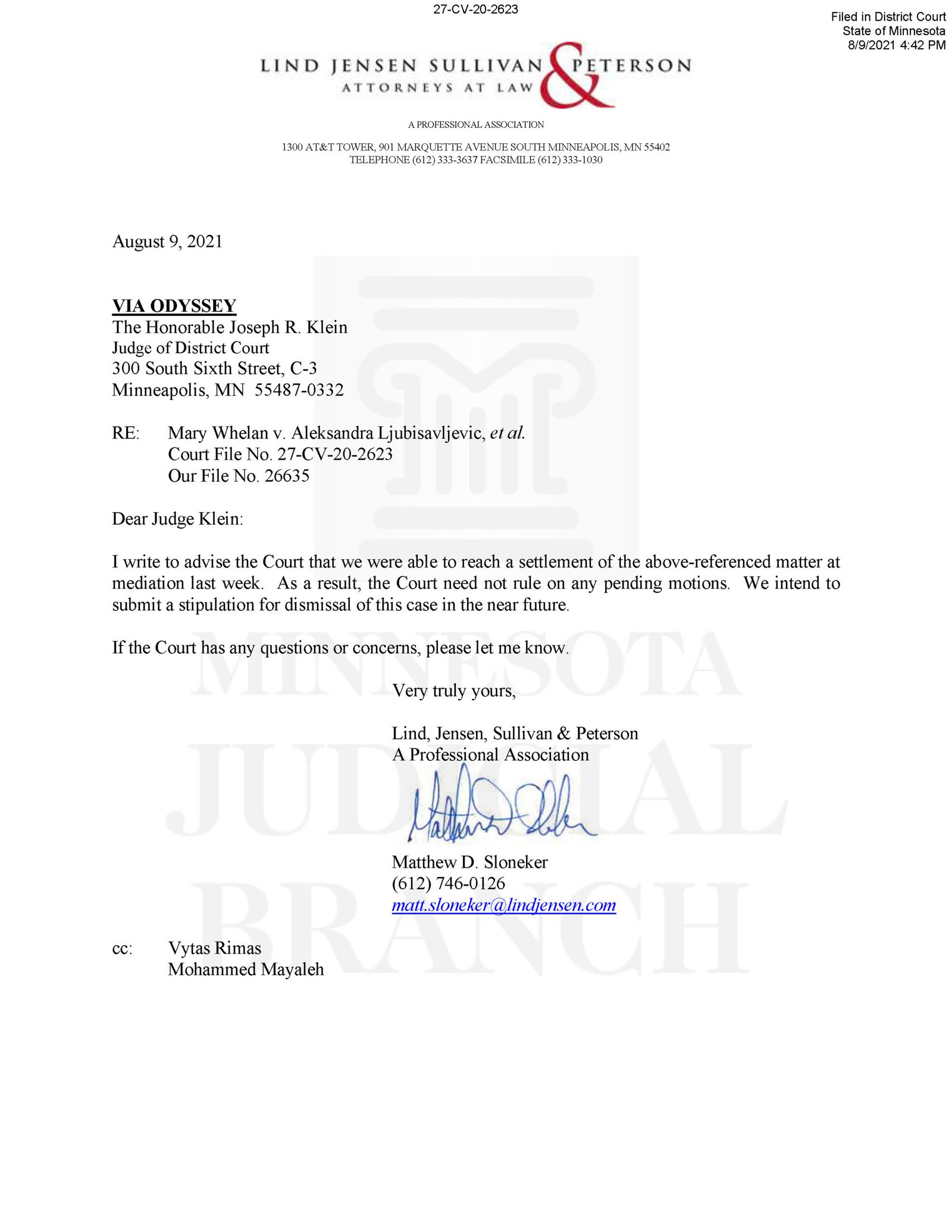
Mary Whelan proved the “case within a case” and received a six figure settlement – meaning she proved the case against Ron Kresha and Golden Shovel Agency, thanks in part to the testimony of Ron Kresha himself.
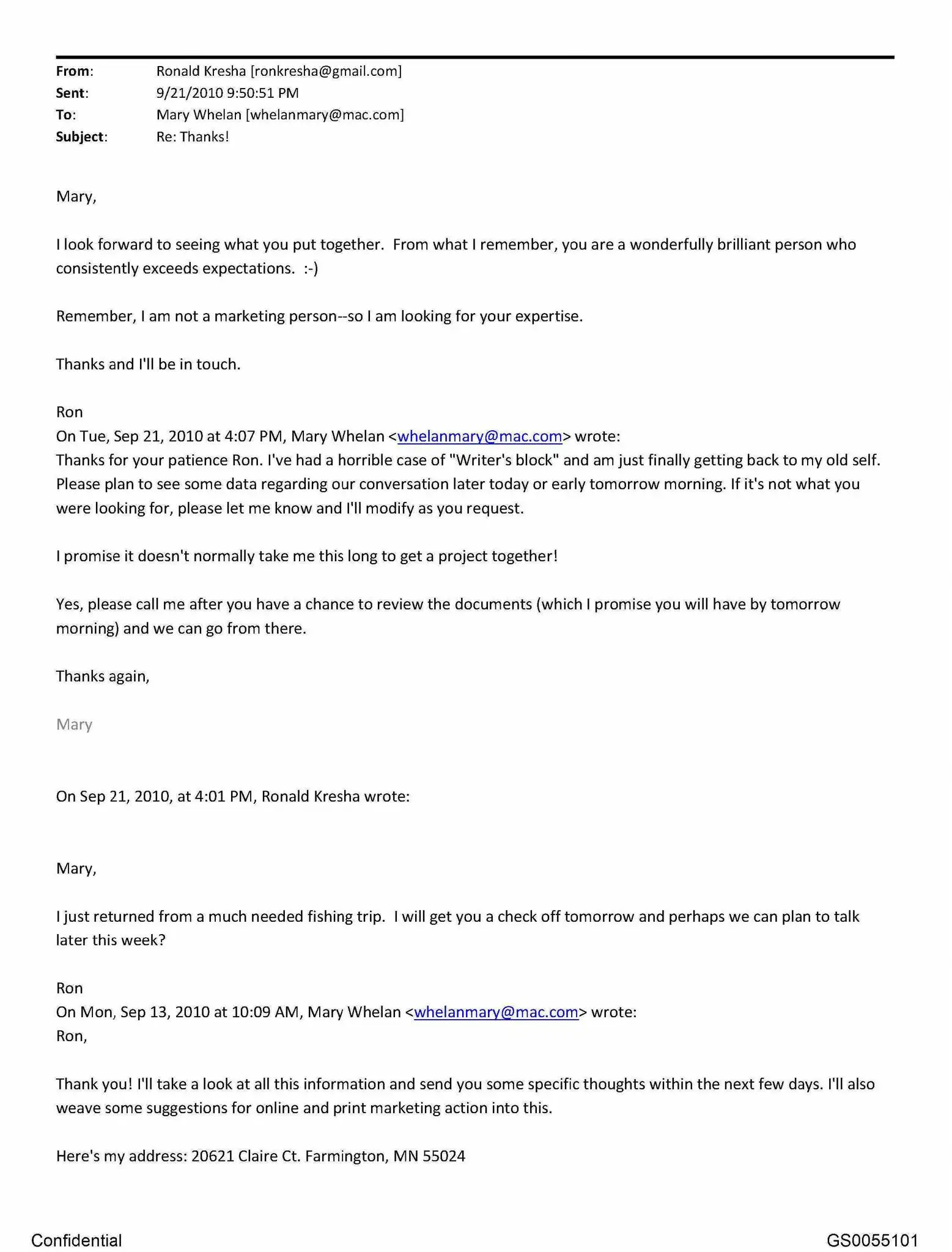
Ron Kresha and Golden Shovel Agency premeditated to defraud Mary Whelan based on knowledge of Whelan’s skills, integrity, and work ethic that Kresha gained from working with Whelan at Atomic Learning. Email chain from September 2010 between Ron Kresha and Mary Whelan in which Kresha praises Whelan’s marketing expertise, relies on her guidance, and discusses payment and ongoing collaboration, reflecting the early professional relationship and reliance on her work.
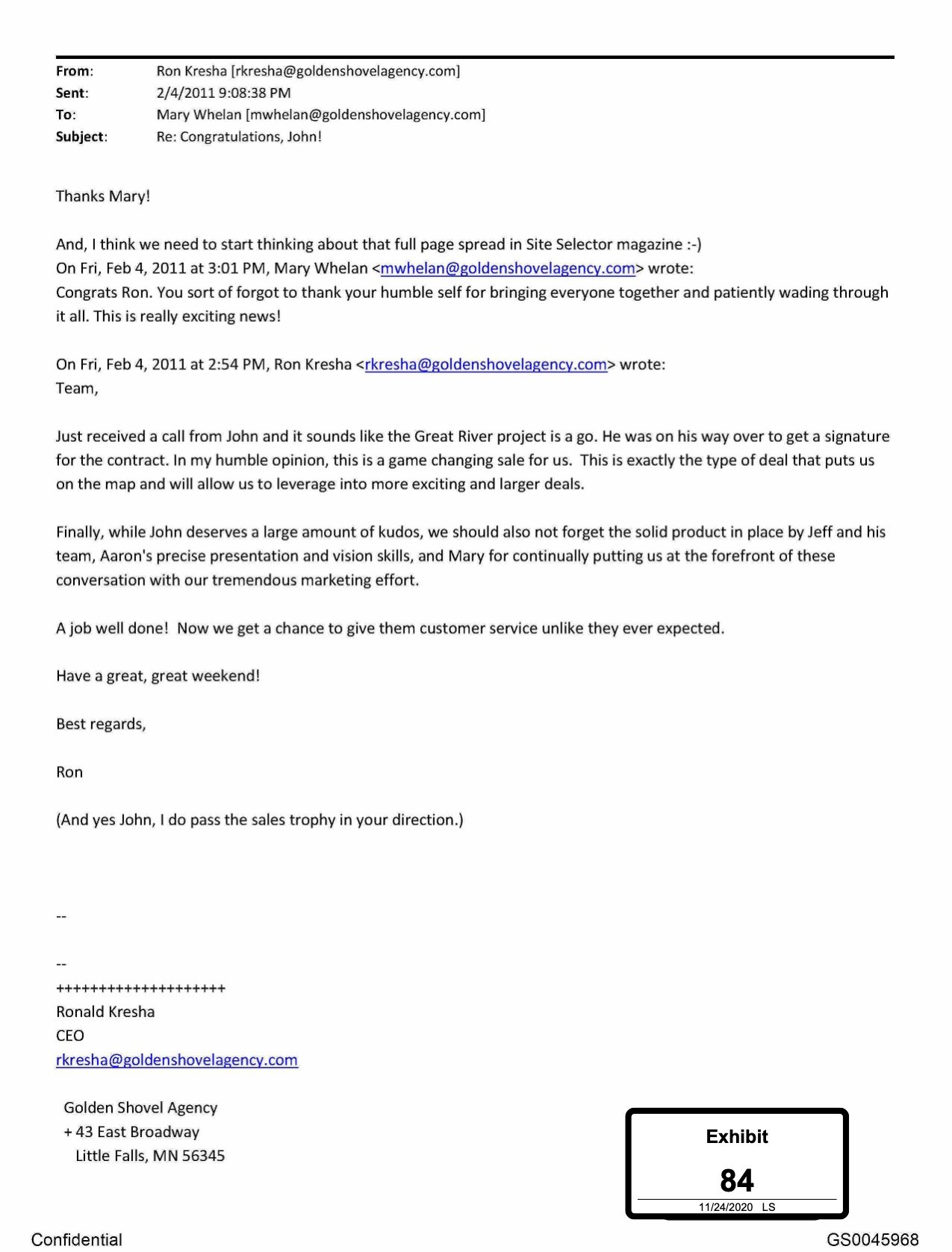
Mary Whelan was instrumental in Golden Shovel Agency cementing that first big sale, but then Ron Kresha withheld the payments and promises he had made to her. Email dated February 4, 2011 from Ron Kresha to Golden Shovel Agency staff praising a major contract win, crediting Mary Whelan for marketing efforts that advanced the company’s success, and discussing leveraging the deal for future growth.
Summary of Internal Company Email (February 25, 2011)
This email, sent by Ron Kresha, CEO of Golden Shovel Agency, to staff members, outlines several positive company updates and organizational changes.
Key points:
-
Promotion:
-
Mary Whelan is promoted from Marketing Manager to Director of Strategic Marketing.
-
Ron explicitly credits her continued growth, dedication, and hard work.
-
-
Project Success:
-
Under Mary’s leadership, a social media kickoff meeting in Red Wing, Minnesota is described as very successful.
-
The effort is positioned as complementary to the Economic Gateway project, with strong market potential.
-
-
Staffing Updates:
-
A new team member (Heidi Thielen) will join John’s team starting March 1.
-
A six-week intern (Kaylah Spar) will assist Mary with the evolution of the company’s social media services.
-
-
Business Development:
-
Team members are traveling for meetings in Kansas and Nebraska, reflecting active sales and client engagement.
-
-
Operational Change:
-
Company-wide meetings will begin Monday mornings at 8:30 a.m., with calendar invites to follow.
-
Overall significance:
This email documents a formal promotion, leadership responsibility, and positive performance recognition for Mary Whelan, along with broader indicators of company growth and internal confidence at Golden Shovel Agency.
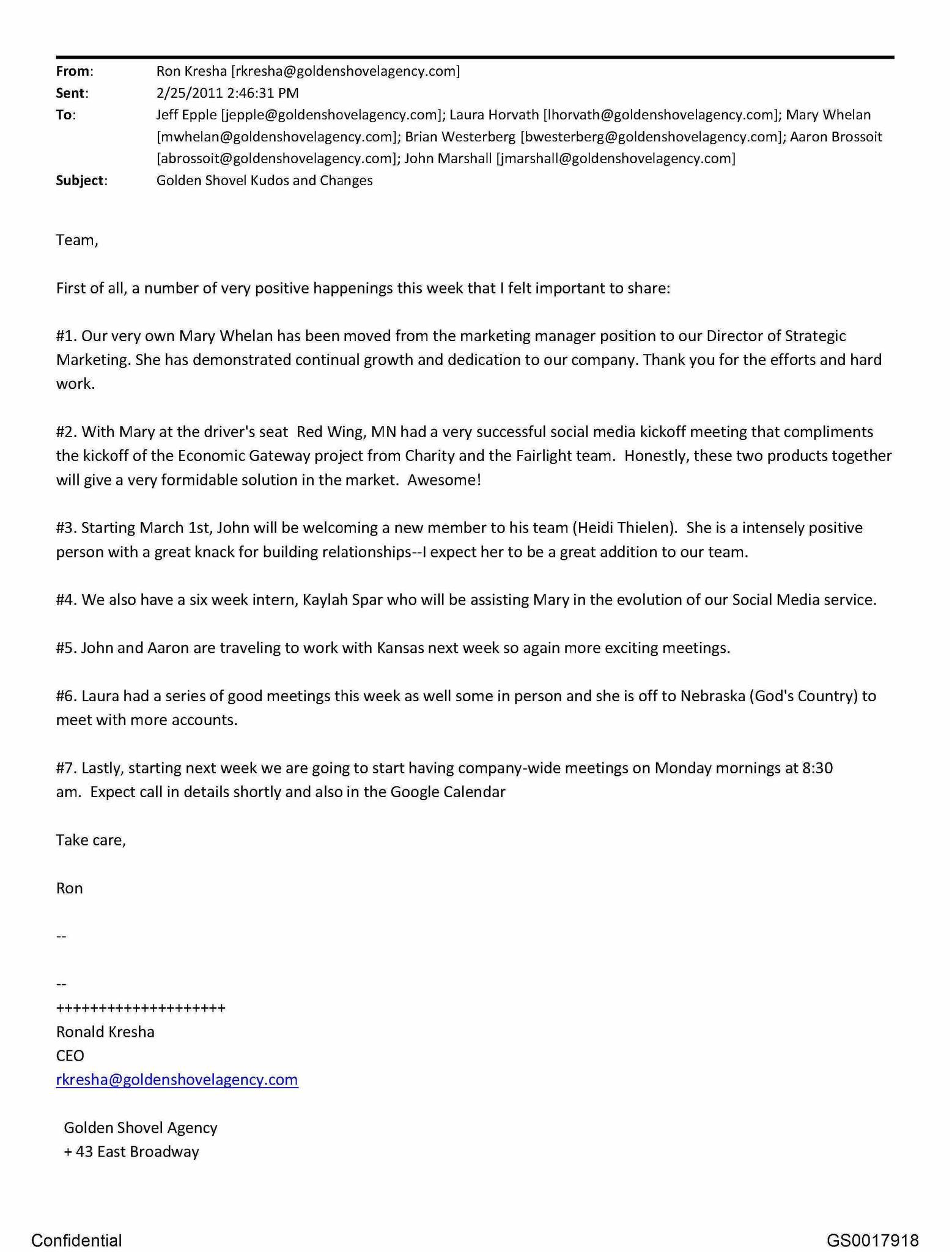
This email, sent by Ron Kresha, CEO of Golden Shovel Agency, to staff members, outlines several positive company updates and organizational changes.
Key points:
Promotion:
Mary Whelan is promoted from Marketing Manager to Director of Strategic Marketing.
Ron explicitly credits her continued growth, dedication, and hard work.
Project Success:
Under Mary’s leadership, a social media kickoff meeting in Red Wing, Minnesota is described as very successful.
The effort is positioned as complementary to the Economic Gateway project, with strong market potential.
Staffing Updates:
A new team member (Heidi Thielen) will join John’s team starting March 1.
A six-week intern (Kaylah Spar) will assist Mary with the evolution of the company’s social media services.
Business Development:
Team members are traveling for meetings in Kansas and Nebraska, reflecting active sales and client engagement.
Operational Change:
Company-wide meetings will begin Monday mornings at 8:30 a.m., with calendar invites to follow.
Overall significance:
This email documents a formal promotion, leadership responsibility, and positive performance recognition for Mary Whelan, along with broader indicators of company growth and internal confidence at Golden Shovel Agency.
On March 7, 2011, Thomas Lambrecht, Economic Development Director at Great River Energy, emailed Ron Kresha, CEO of Golden Shovel Agency, confirming that:
He received the signed contract and the invoice from Golden Shovel Agency.
The invoice has been submitted for internal processing.
Great River Energy’s payment cycle typically takes about one week to complete.
A signed contract PDF (“Great River Energy Contract – signed.pdf”) is referenced as an attachment.
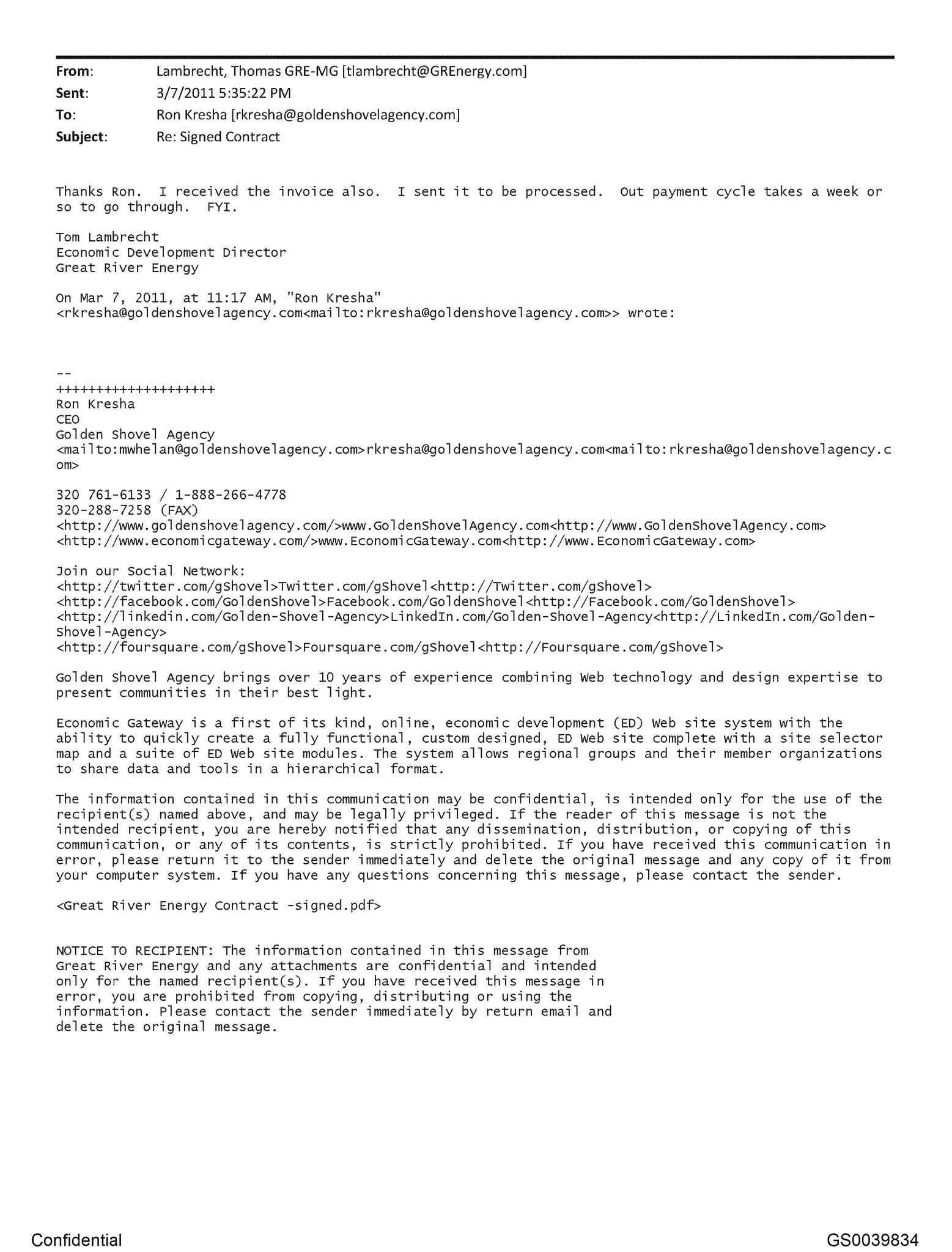
He received the signed contract and the invoice from Golden Shovel Agency.
The invoice has been submitted for internal processing.
Great River Energy’s payment cycle typically takes about one week to complete.
A signed contract PDF (“Great River Energy Contract – signed.pdf”) is referenced as an attachment.
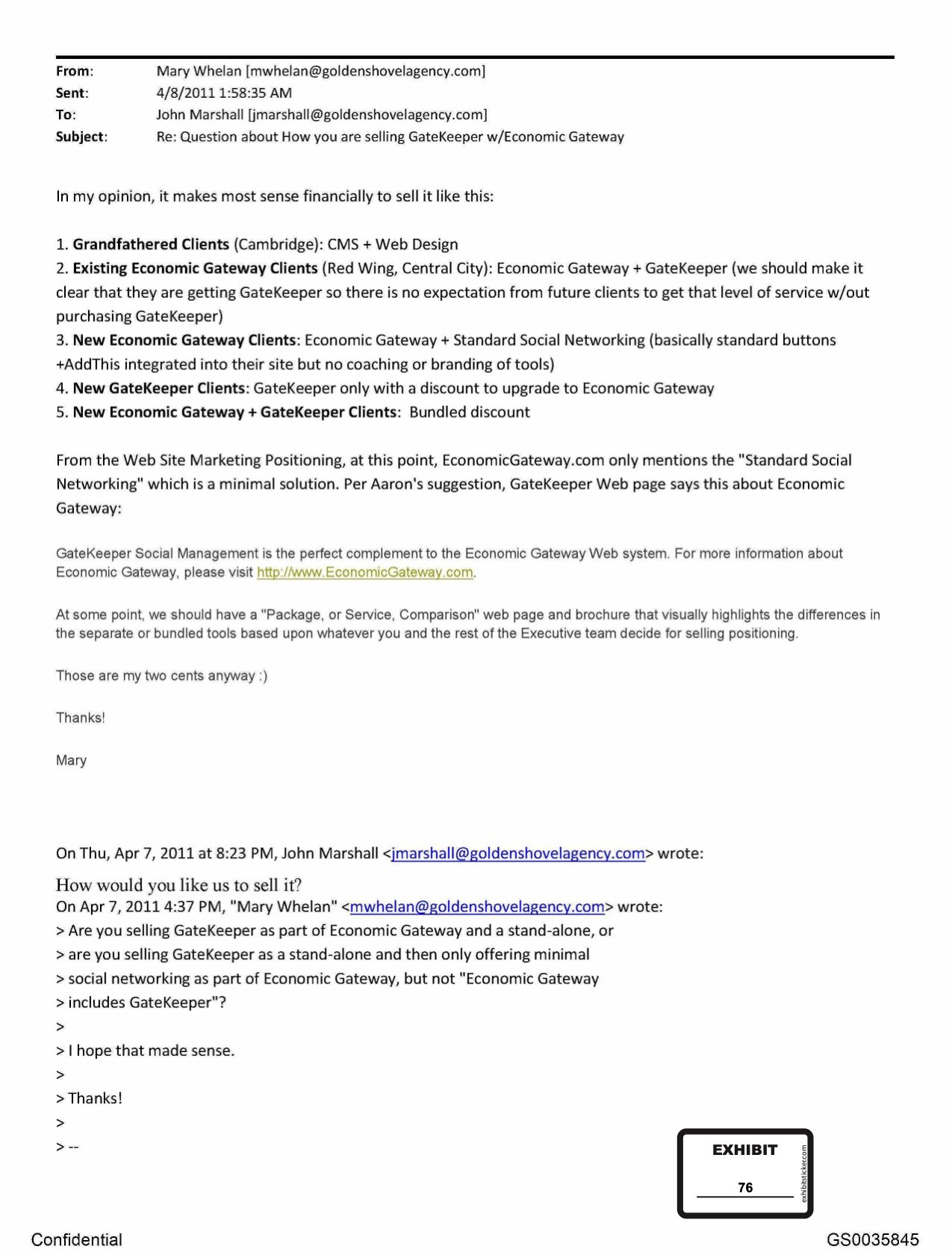
Email dated April 8, 2011 from Mary Whelan to John Marshall outlining detailed pricing, bundling, and sales strategy for selling the Gatekeeper platform with Economic Gateway, demonstrating her role in product positioning and commercialization decisions.
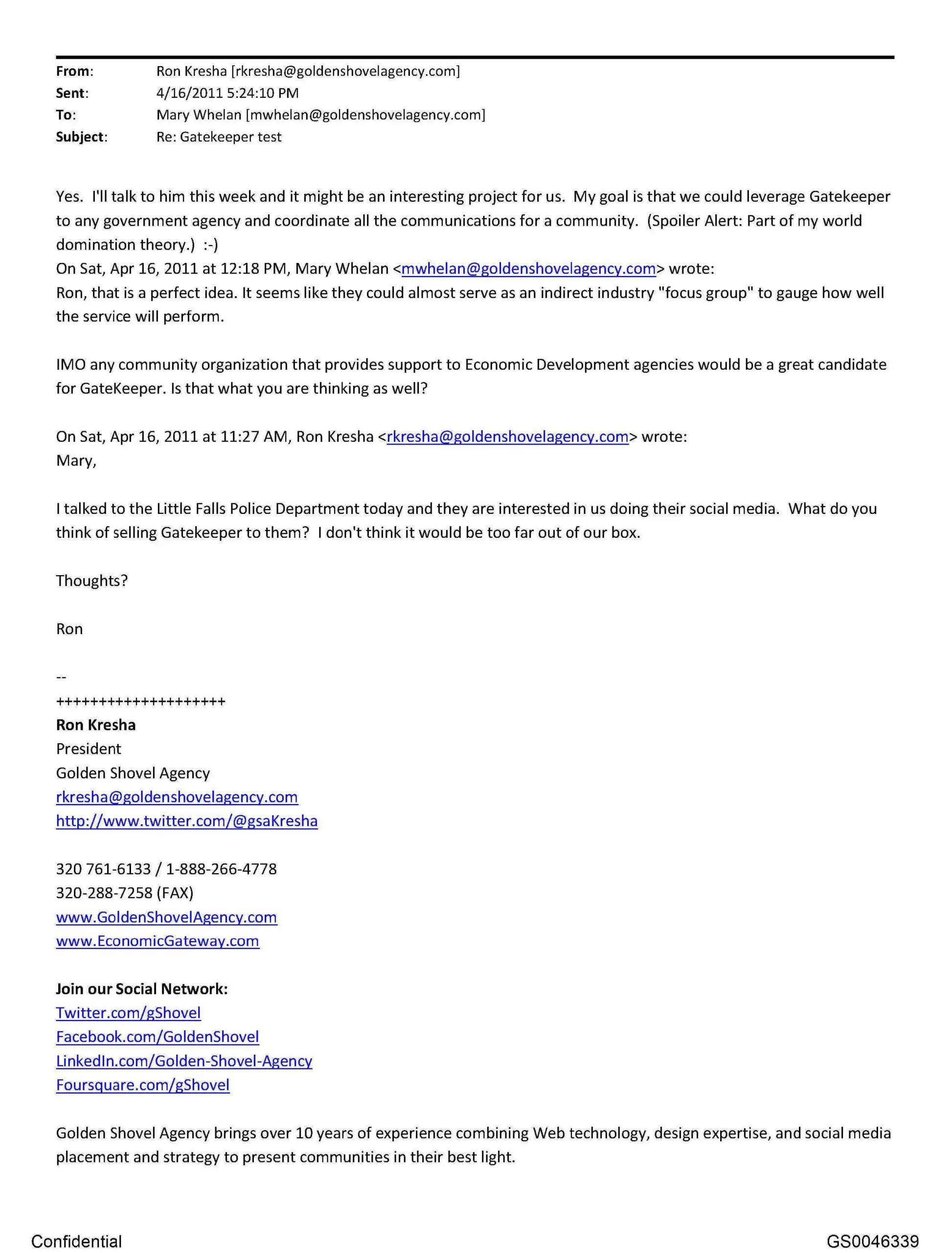
Email chain from April 16, 2011 between Ron Kresha of Golden Shovel Agency and Mary Whelan discussing testing and selling the Gatekeeper platform, including targeting government and community organizations such as a police department, showing collaborative planning and development ideas.
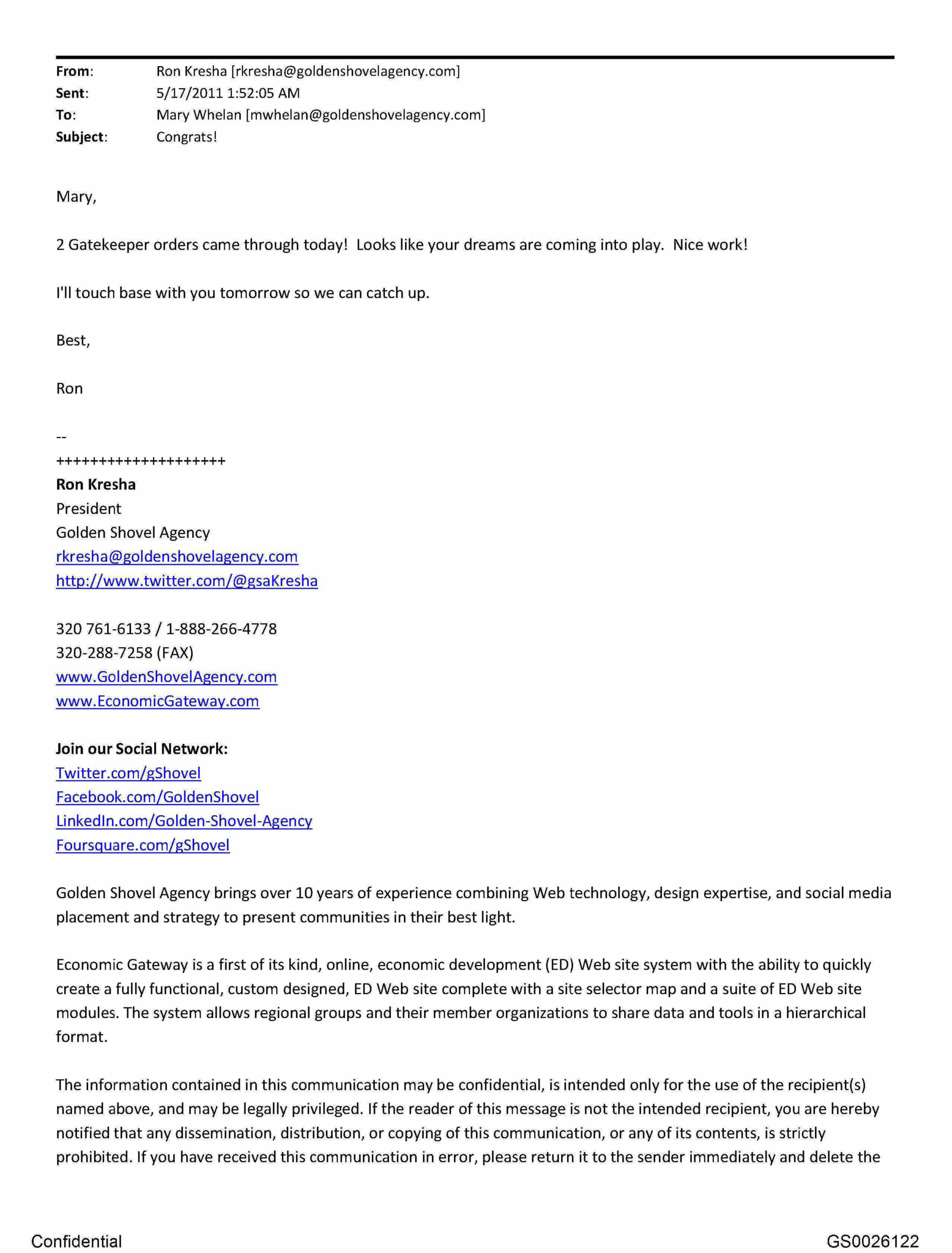
Email dated May 17, 2011 from Ron Kresha, president of Golden Shovel Agency, to Mary Whelan congratulating her on receiving two Gatekeeper orders and praising her work, indicating early commercial success of the Gatekeeper product.
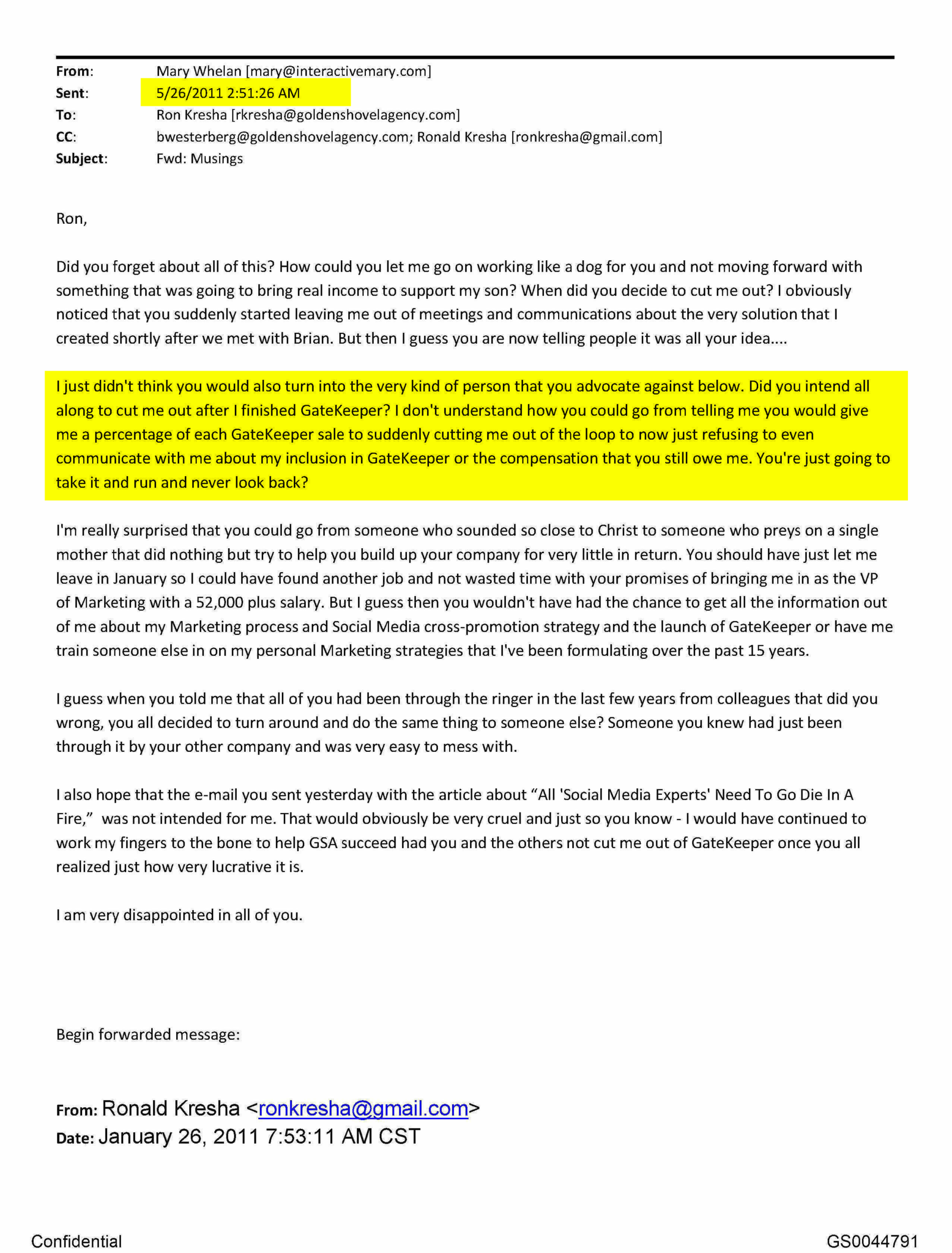
Email dated May 26, 2011 from Mary Whelan to Ron Kresha accusing Golden Shovel Agency leadership of cutting her out of the Gatekeeper project after completion, referencing promises of revenue sharing and compensation, and expressing distress over unpaid work and exclusion from communications.
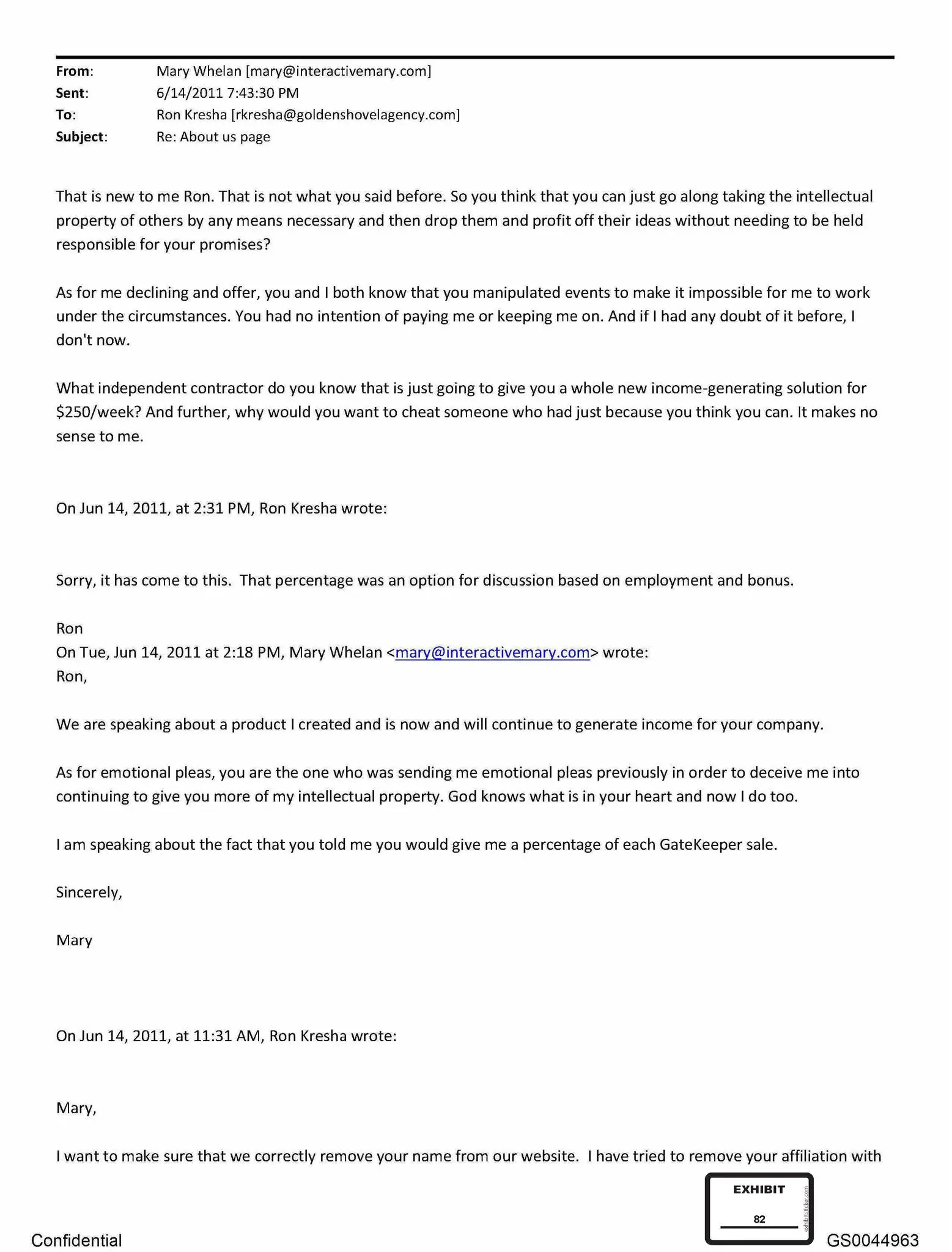
Email exchange dated June 14, 2011 between Mary Whelan and Ron Kresha in which Whelan asserts she created the Gatekeeper product, demands that Golden Shovel Agency stop using her name, skills, and intellectual property for sales unless she is compensated, and references a promised percentage of Gatekeeper sales, with Kresha responding with a lie about the promise of her percentage of Gatekeeper sales hinging on her employment with Golden Shovel Agency.
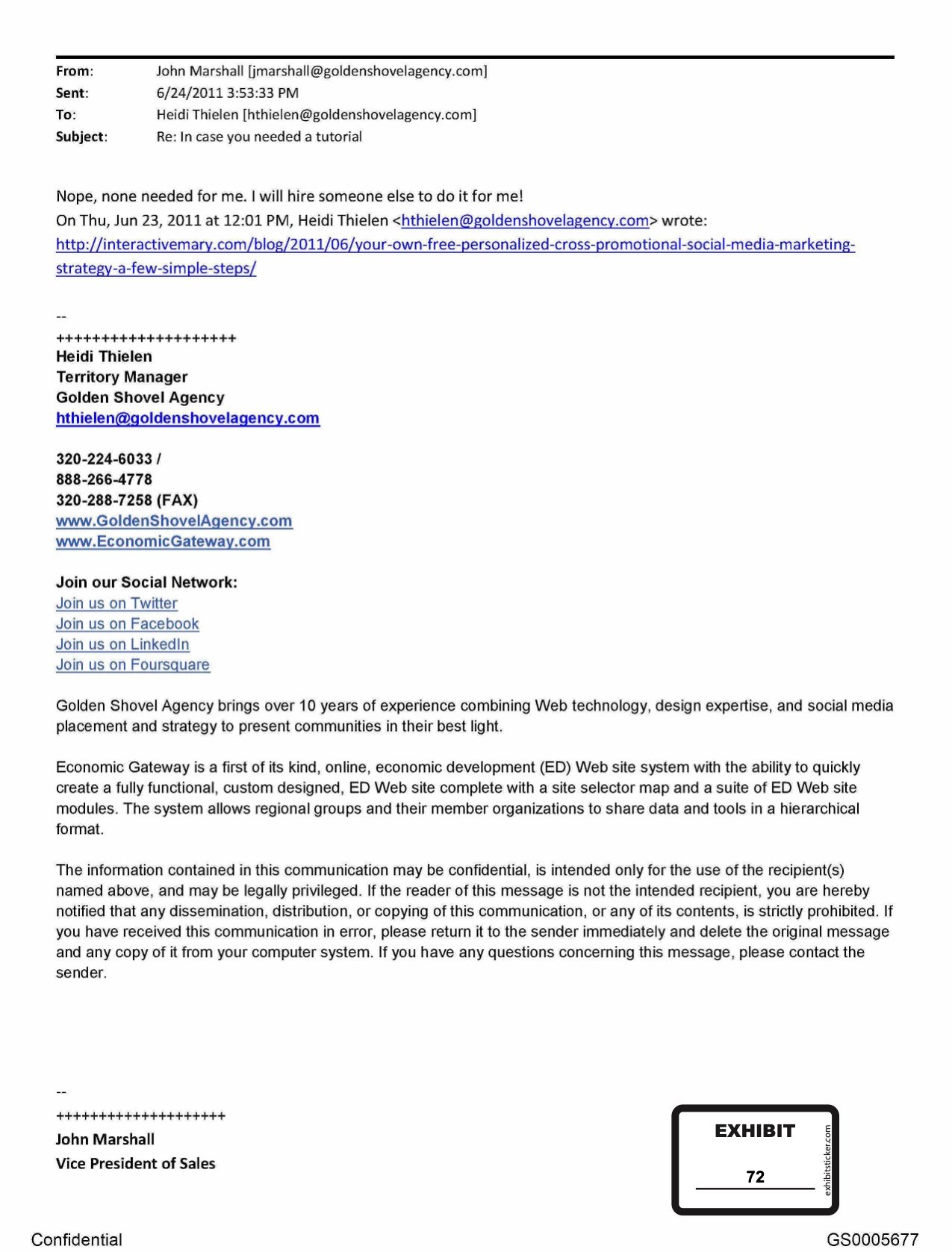
Email dated June 24, 2011 between Golden Shovel Agency employees John Marshall and Heidi Thielen referencing a blog post by Mary Whelan on InteractiveMary.com about social media marketing strategy, indicating internal use of her published content while discussing outsourcing the work.
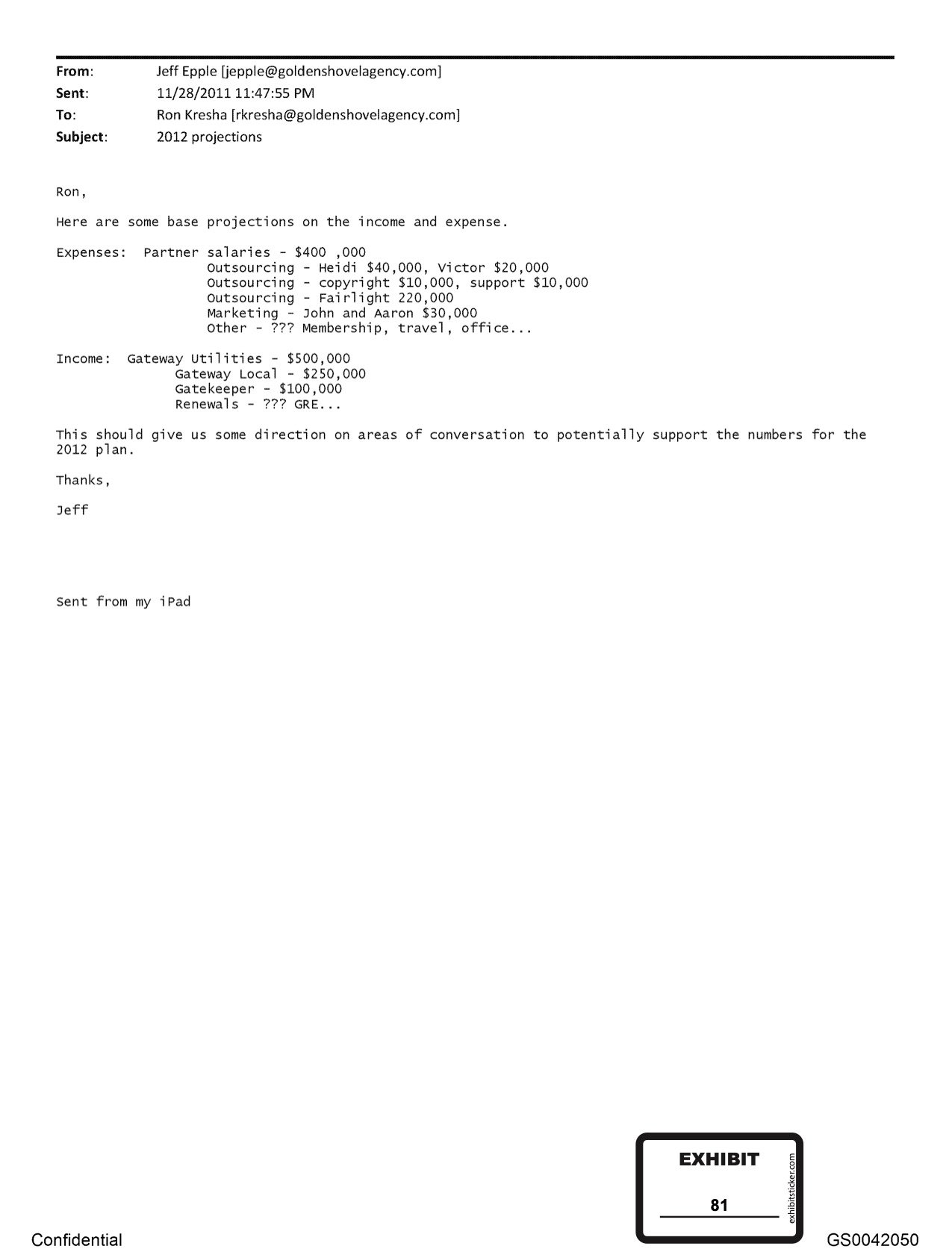
Email dated November 28, 2011 from Jeff Epple to Ron Kresha outlining 2012 income and expense projections for Golden Shovel Agency, including projected Gatekeeper revenue of $100,000 alongside other product and service income.
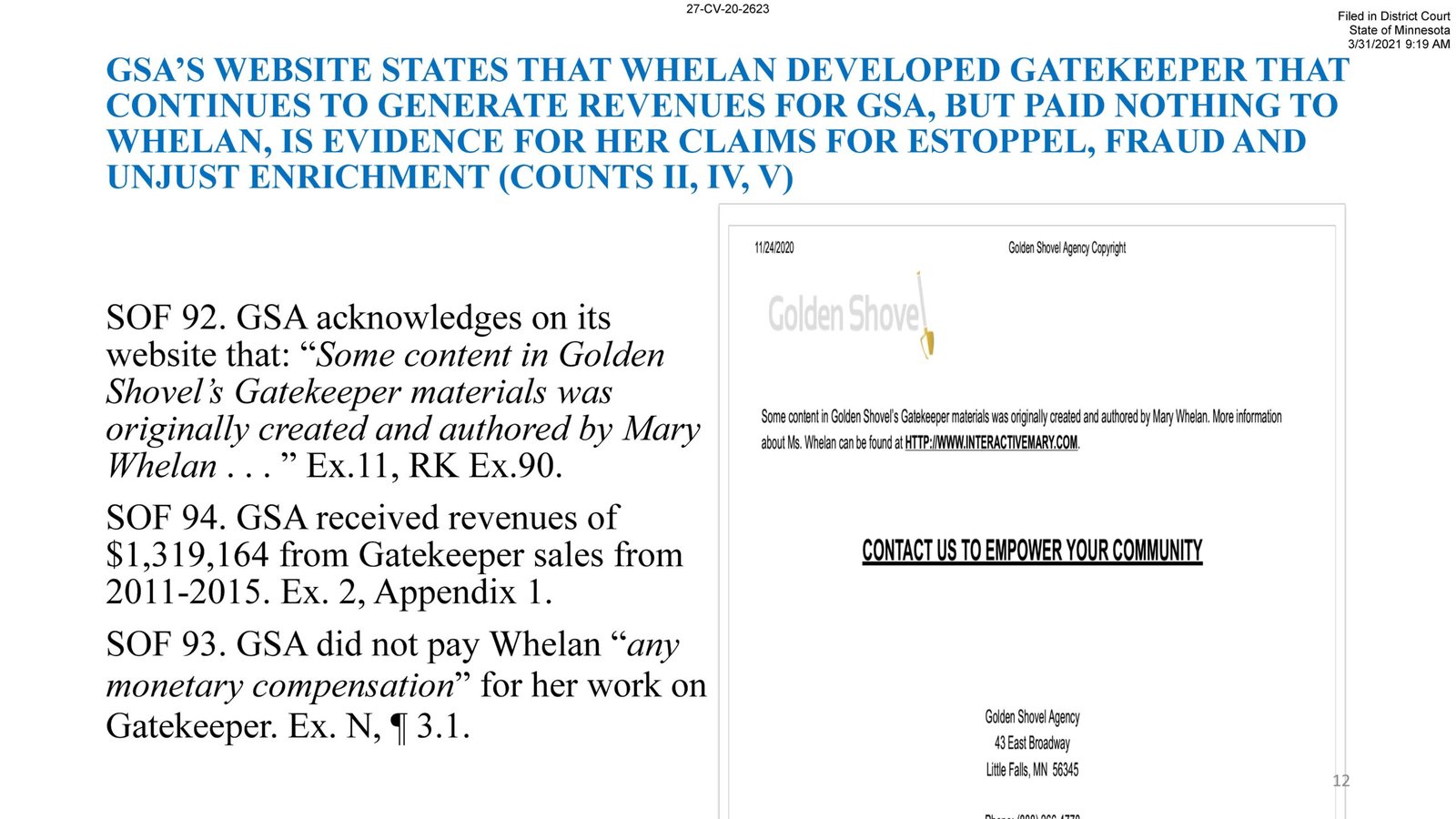
Court filing excerpt stating that Golden Shovel Agency acknowledged on its website that Mary Whelan created content for the Gatekeeper product, that GSA earned over $1.3 million in Gatekeeper sales from 2011–2015, and that Whelan was not paid, cited as evidence for estoppel, fraud, and unjust enrichment claims.
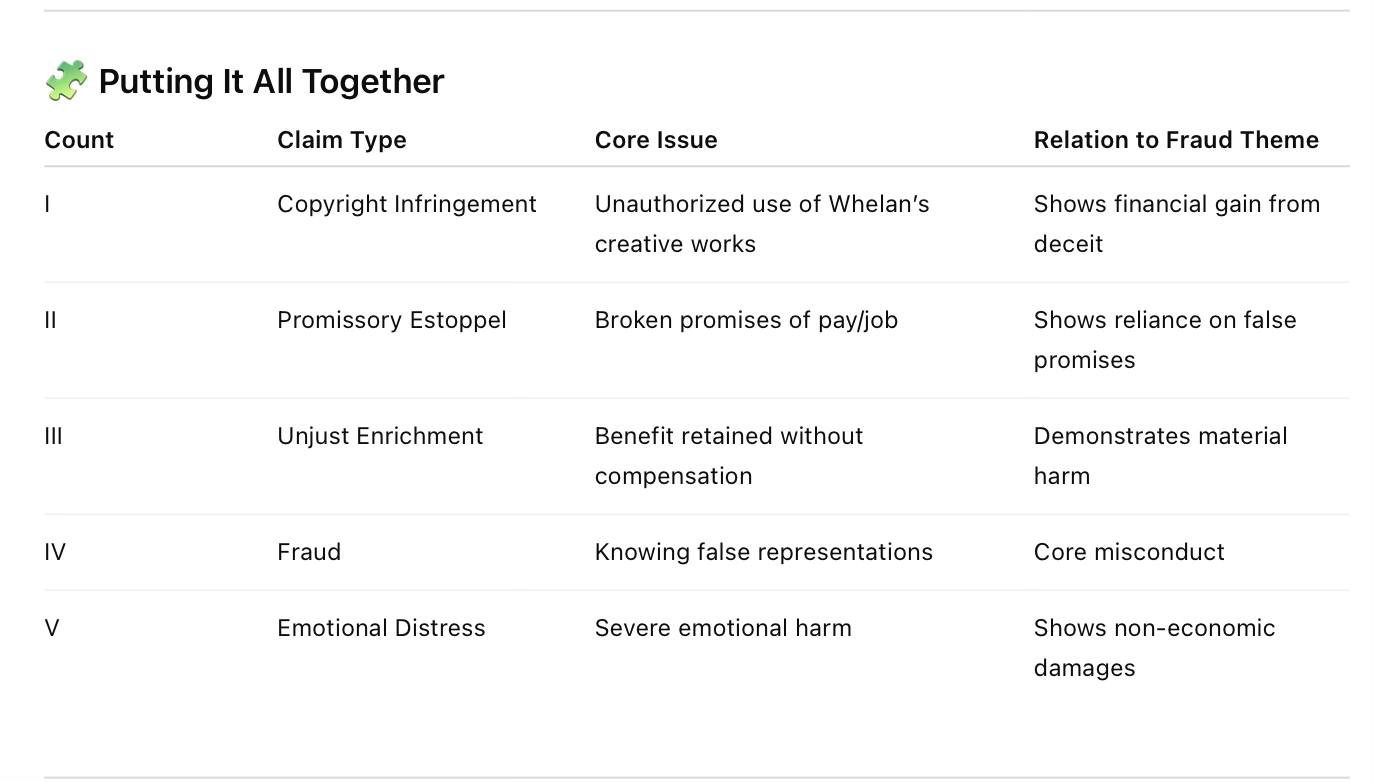
In a Similar Fraud Case, Ron Kresha Abruptly Retires, Golden Shovel Agency Hires Criminal Lawyer as $965K Federal Fraud Case Engulf His Company

I. Background: A Career Built, Then Strategically Undermined
Mary Whelan is a marketing strategist, designer, and product developer whose work has contributed materially to multiple technology and education-focused companies. Beginning in 2007, Whelan worked at Atomic Learning, where she became a critical member of the team and contributed to the company’s success through design, marketing, and strategic initiatives.
By 2010, Whelan was earning nearly $50,000 annually, with substantial benefits including health insurance, an HSA, four weeks of paid time off, and a 401(k) match. She was financially stable and professionally established.
However, the period leading up to her separation from Atomic Learning was marked by escalating internal pressure. A year before her termination, a close family friend of Ron Kresha—a major investor and board member of Atomic Learning—contacted Whelan requesting her professional portfolio, stating that “someone in the community wanted to see it.” At the same time, Whelan’s direct supervisor—Kathy Sell (Kathy Schroeder)—engaged in conduct that appeared calculated to push her out of the company.
In 2009, in an effort to stop the mistreatment, Whelan disclosed to her supervisor that she suffered from post-traumatic stress disorder (PTSD) stemming from a near-death experience in 2004, when both Whelan and her young child were the targets of an attempted homicide. This disclosure was made in confidence and in good faith. Instead of improving conditions, the supervisor’s behavior worsened.
By the time Atomic Learning terminated Whelan’s employment in July 2010, she was emotionally destabilized, professionally displaced, and suddenly without the income and benefits that had supported both herself and her child. Kresha, as a board member and investor, was aware of the circumstances surrounding her departure.
By the time her employment was terminated, Whelan was already destabilized — and those closest to the situation knew it.
II. Recruitment into Golden Shovel Agency
On August 23, 2010, shortly after Whelan’s termination from Atomic Learning, Kresha contacted her via LinkedIn to ask whether she would be interested in helping with “small projects” at his new startup, Golden Shovel Agency (GSA). He asked for her contractor rates. Shortly thereafter, he sent her a random $250 check, without a formal agreement.
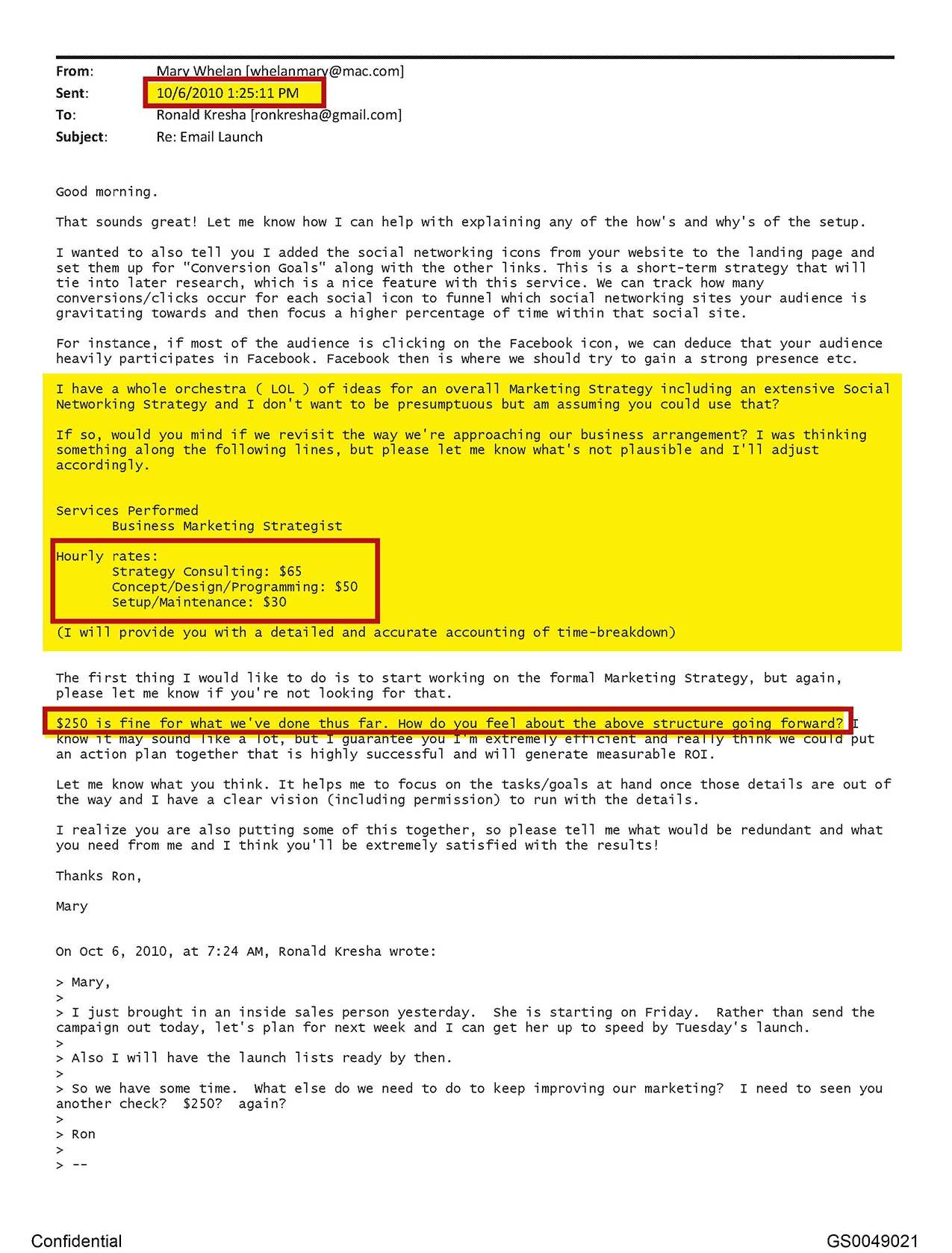
On October 6, 2010, Whelan sent Kresha her contractor rates in writing, explicitly stating that $250 would not be sufficient going forward. The work she had already completed bore her own logo and name, reflecting her understanding that she was operating as an independent contractor.
On October 18, 2010, Whelan submitted a formal invoice. After receiving it, Kresha called her and described severe personal and financial hardship: his family struggling to survive, his eldest son forced to quit baseball to get a job, his wife taking a newspaper job, and five children to support. He stated that Atomic Learning had “destroyed his life too.”
During that call, Kresha asked Whelan to become Marketing Manager for Golden Shovel Agency. He proposed paying her $500 per week through December 2010, at which point the company expected to close the NWKREC contract. He promised that once that contract closed, she would be brought on full-time at $55,000 per year, with an increase to $60,000 as soon as possible. He told her she would be “on the ground floor” of the startup, with profit sharing and a role akin to a partner—similar to Jeff Epple and Aaron Brossoit, who were contributing labor in lieu of cash while other partners provided capital.
Based on these representations, Whelan agreed.
III. Employment in Practice: Title, Authority, and Reliance
On November 1, 2010, Kresha issued Whelan a Golden Shovel Agency email address and began introducing her publicly as the company’s Marketing Director. Internal and external materials later identified her as Director of Strategic Marketing and, in some documents, VP of Marketing, on the same organizational level as other company principals.
Ron Kresha promised that Mary Whelan would be brought on as Vice President of Marketing at Golden Shovel Agency, with a salaried position. Separately and in addition to that role, he stated that Golden Shovel Agency would sell Whelan’s independently created product, GateKeeper, and that she would receive a percentage of GateKeeper sales.
At this point, Whelan reasonably believed she was no longer acting as an outside contractor, but as a core member of the company. She stopped placing her personal logo on work product and instead produced materials under the Golden Shovel brand.
Over the following months, Whelan:
-
Designed and executed GSA’s marketing strategy
-
Built social media systems and processes
-
Created client-facing content and campaigns
-
Developed a new product offering, later branded GateKeeper Social Management
-
Defined GateKeeper’s pricing, positioning, bundling strategy, and sales use cases
-
Produced live examples and demonstrations used to close sales
GateKeeper was Whelan’s idea, and she created and developed it independently, working from her own home on her own computer. No employment or IP assignment agreement transferred ownership of the underlying intellectual property.
“GateKeeper was my idea. I built it independently, on my own computer, at my own home.”
IV. GateKeeper: Creation, Use, and Monetization
By early 2011, GateKeeper was being actively sold to Golden Shovel clients. Internal emails show Whelan explaining exactly how GateKeeper should be packaged, bundled, discounted, and positioned alongside Economic Gateway. Her work was used to support live sales efforts, including time-sensitive demonstrations requested by sales leadership.
Despite this, Whelan’s compensation did not materialize as promised. Payments became inconsistent, significantly lower than agreed upon, and at times nonexistent.
The compensation structure described to Whelan consisted of two distinct parts: a salaried executive role as Vice President of Marketing, and a separate revenue share tied specifically to sales of GateKeeper, a product she had created independently.
Q: Who created GateKeeper Social Management?
A: GateKeeper was conceived, designed, and developed by Mary Whelan independently before being commercialized by Golden Shovel Agency.
Q: What compensation was Mary Whelan promised for her work?
A: Ron Kresha stated that Mary Whelan would be brought on as Vice President of Marketing at Golden Shovel Agency with a salaried position, and separately that Golden Shovel Agency would sell her independently created product, GateKeeper, with Whelan receiving a percentage of GateKeeper sales.
Q: Was Mary Whelan paid for GateKeeper?
A: The documentary record shows she was not compensated as promised and later withdrew consent for use of her work.
If they were not going to pay her for her work or intellectual property, they did not have permission to use it.
V. Introduction of Atomic Learning Employees and Escalation
During early discussions, Kresha had explicitly promised Whelan that he would not bring Atomic Learning personnel into Golden Shovel Agency, acknowledging her traumatic experience there. Despite this, two women from Atomic Learning—Heidi Thielen and Julie Schulte—were later brought into GSA.
Their arrival coincided with a sharp change in workplace dynamics. Whelan experienced behavior she described as bullying and marginalization, closely mirroring the conduct she had endured at Atomic Learning. These actions triggered severe emotional distress and exacerbated her PTSD.
At the same time:
-
Thielen and Schulte began assuming duties Whelan had built
-
They began bullying and undermining her
-
They challenged her authority
-
They were paid
-
Whelan was not
-
GateKeeper and related materials continued to be sold
Kresha was aware of Whelan’s PTSD and her history. When she reached out to him seeking clarification and support, his demeanor shifted. He minimized concerns and began asserting that the company lacked funds to compensate her—despite ongoing sales activity using her work.
He promised he would never bring Atomic Learning people into the company. Then he did.
VI. The Atomic Learning Network Reappears
A major precipitating event occurred when Kathy Schroeder (now Kathy Sell), Whelan’s former supervisor at Atomic Learning, was invited into a meeting at Golden Shovel Agency.
Schroeder Sell was accompanied by Lisa Barnett, her best friend and the then-President of Atomic Learning.
Relevant background:
-
Barnett and Schroeder Sell had both worked at Russell Herder Advertising in Brainerd, Minnesota, where Whelan had also worked (Barnett stayed at Russell Herder while Schroeder Sell moved on to the Brainerd Chamber of Commerce).
-
Barnett later brought Whelan into Atomic Learning and initially supervised her
-
Over a year later, Barnett brought Schroeder Sell into Atomic Learning, at which point Schroeder Sell became Whelan’s direct supervisor while Barnett moved into a VP of Marketing role
-
Barnett later assumed Ron Kresha’s former role as President of Atomic Learning
At the Golden Shovel meeting, Whelan observed that Schroeder Sell and Barnett were still very much socially aligned with Thielen and Schulte.
To Whelan, this made clear that:
-
The same supervisory and executive network that preceded her termination at Atomic Learning was now present inside Golden Shovel Agency
-
The promise that GSA would not replicate Atomic Learning dynamics had been broken
This meeting significantly escalated her distress.
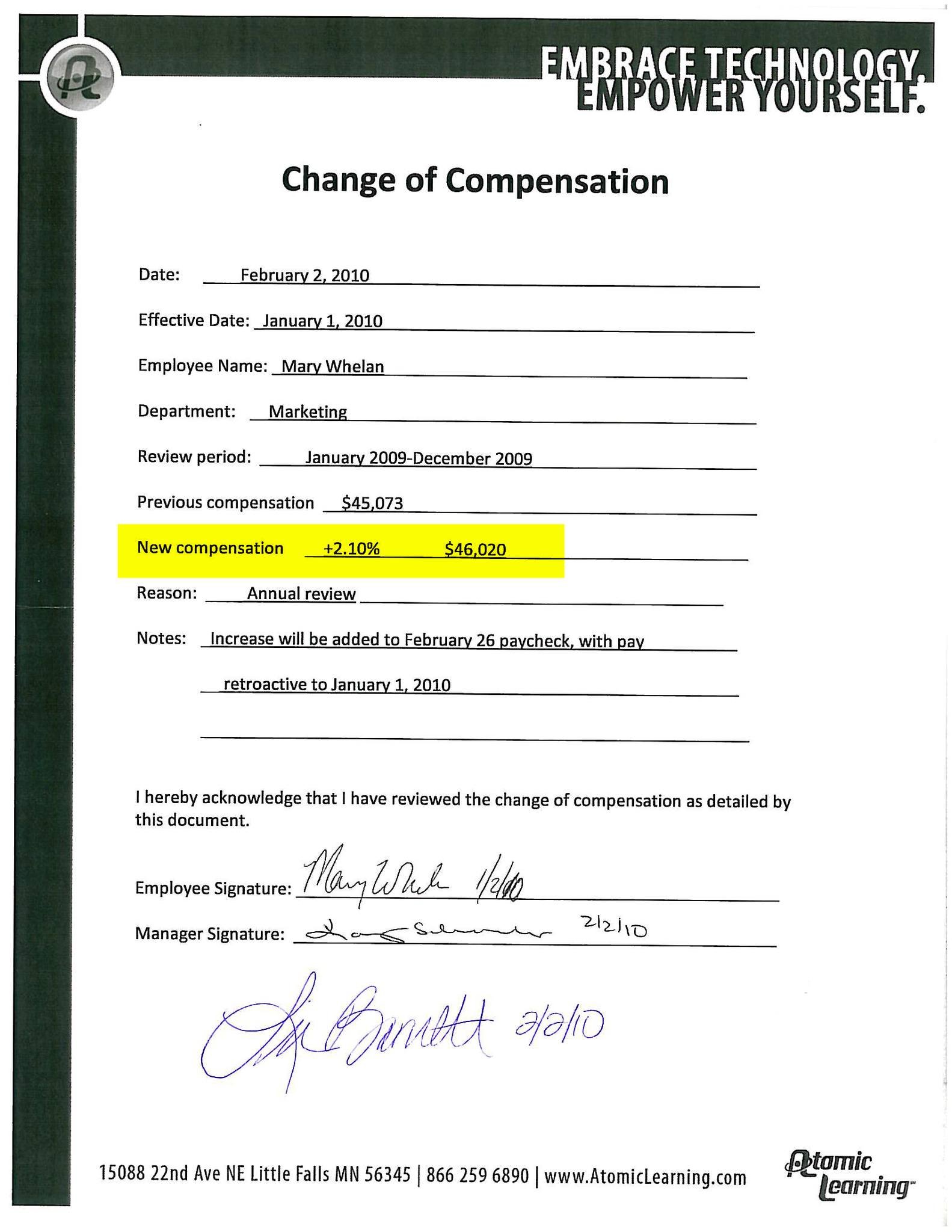
This document records an approved salary increase for Mary Whelan, an employee in the Marketing Department at Atomic Learning, following an annual performance review.
Key details:
Document date: February 2, 2010
Effective date of raise: January 1, 2010
Review period: January 2009 – December 2009
Previous salary: $45,073
New salary: $46,020
Increase amount: 2.10%
Reason for change: Annual review
Payroll note: The increase was applied retroactively to January 1, 2010, and added to the February 26 paycheck.
The document includes acknowledgment signatures from the employee (Mary Whelan) and management, confirming review and approval of the compensation change.
Overall significance:
This is a formal HR record documenting a merit-based annual raise, indicating satisfactory or positive performance during the review period.
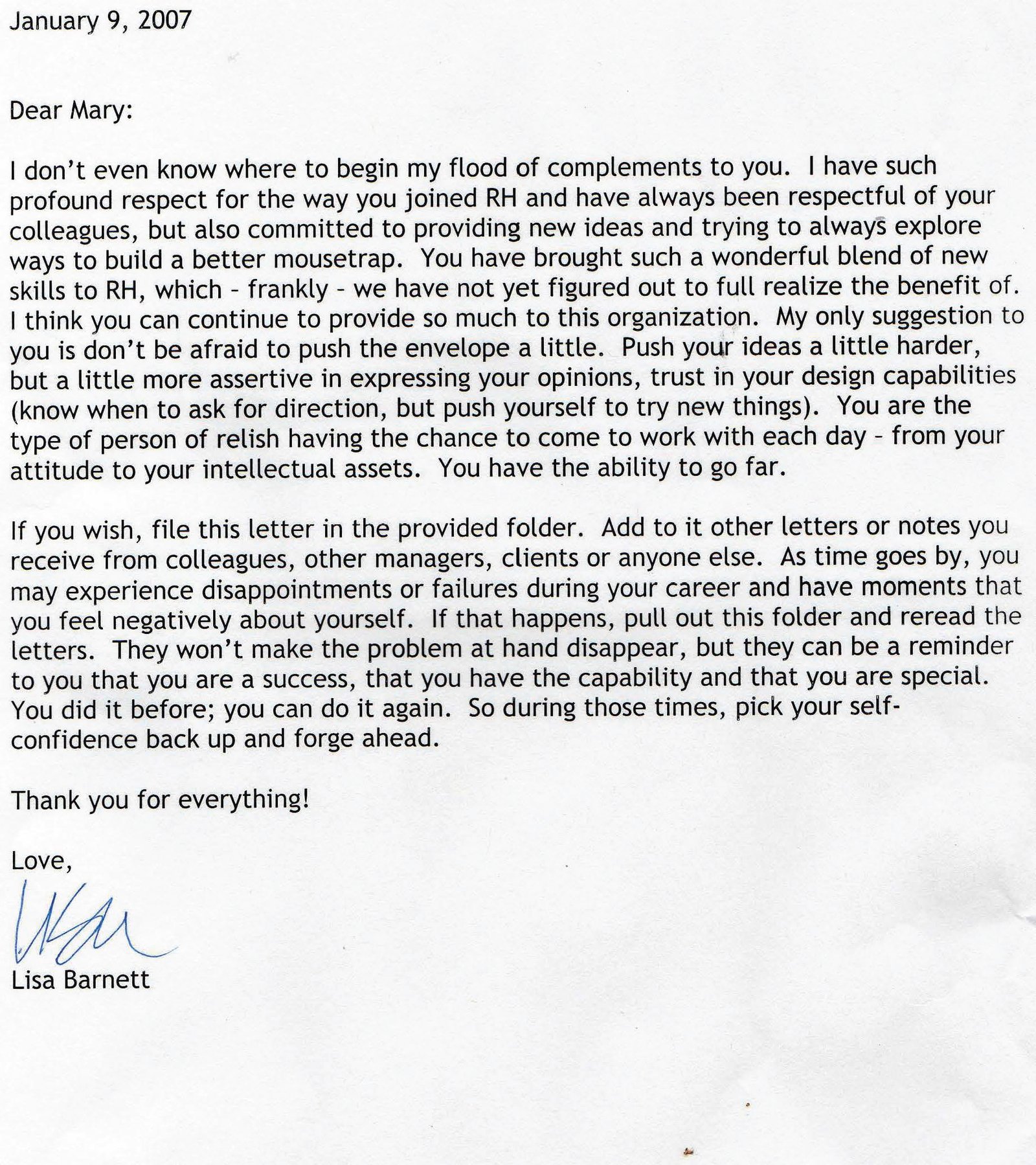
This letter, written by Lisa Barnett to Mary, is a highly positive professional commendation. The author expresses strong respect and appreciation for Mary’s work, character, and contributions after joining RH. Key points include:
Mary is praised for her professionalism, respect for colleagues, creativity, and willingness to explore new ideas.
The author highlights Mary’s design skills, intellectual strengths, and potential for long-term success, noting that the organization has not yet fully leveraged her abilities.
Constructive encouragement is offered, advising Mary to be more assertive, push her ideas further, and trust her capabilities while continuing to grow.
The letter emphasizes Mary’s value to the organization and her positive daily impact.
The closing section encourages Mary to keep the letter as a reminder of her competence and success, especially during future career challenges or moments of self-doubt.
Overall tone: Supportive, affirming, and motivational.
Purpose: Professional encouragement, recognition of talent, and long-term morale support.
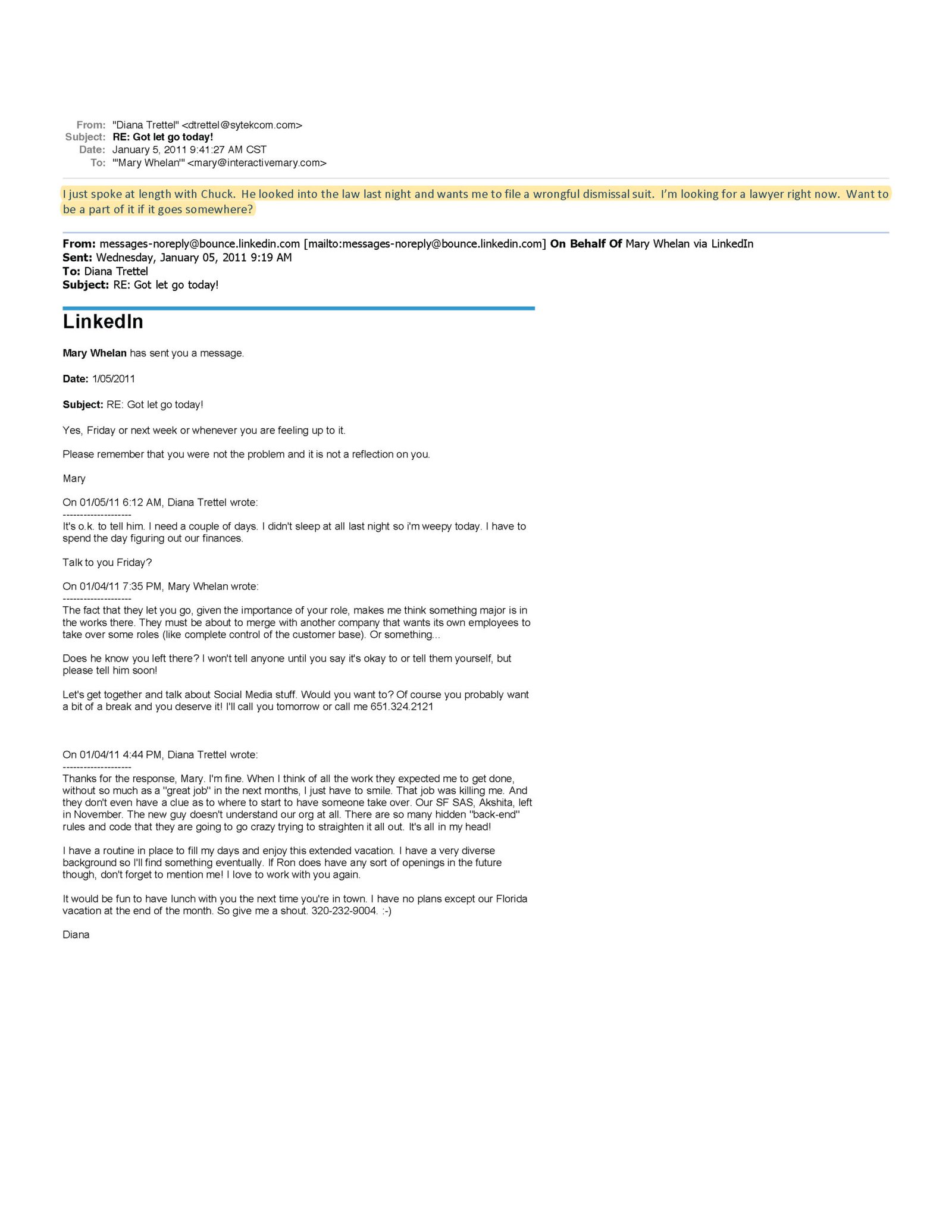
This document is a multi-message email and LinkedIn correspondence primarily between Mary Whelan and Diana Trettel, following Diana’s termination from her job at Atomic Learning.
Key points:
Termination: Diana Trettel reports that she was “let go” from her position in early January 2011.
Emotional and financial stress: Diana describes being exhausted, stressed, and needing time to process the situation and assess her finances.
Support from Mary Whelan:
Mary reassures Diana that the termination was not her fault and not a reflection of her abilities.
Mary offers emotional support, professional encouragement, and help reconnecting in the future.
Speculation about company motives: Mary suggests the termination may be related to organizational restructuring, mergers, or control over customer roles, rather than performance.
Legal consideration:
In a highlighted message, Diana states she spoke at length with “Chuck,” who reviewed the law and wants her to file a wrongful dismissal lawsuit.
Diana indicates she is actively looking for a lawyer and asks whether Mary wants to be involved if the situation escalates.
Ongoing relationship: The exchange includes plans to meet, continue professional collaboration, and remain in contact, reflecting mutual respect and a positive working relationship.
Overall significance:
This correspondence documents a sudden termination, emotional distress, peer support, and contemplation of legal action for wrongful dismissal, while also showing that colleagues did not view the termination as performance-related.
VII. Request for Clarification and Shift in Conduct
Following these events, Whelan contacted Ron Kresha seeking clarification about what was happening.
According to Whelan, Kresha’s demeanor shifted markedly. Where he had previously been affirming and communicative, he became distant and dismissive.
When Whelan again requested payment, Kresha asserted that the company did not have funds to pay her, despite GateKeeper being actively sold and other personnel being compensated.
VIII. Assertion of Rights and Retaliatory Framing
When Whelan was not paid, she contacted Jeff Epple and Aaron Brossoit, informing them that if she was not being compensated for her labor or intellectual property, Golden Shovel Agency did not have her permission to use or resell her work.
Subsequently:
-
Whelan was pushed out
-
Her product continued to be used
-
Internal emails characterized her as a “disgruntled former employee”
-
Heidi Thielen later bragged internally about taking material from Whelan’s personal website
In one instance, after Whelan informed a GateKeeper client that she had created the product and was not being compensated, internal correspondence mocked and dismissed her while continuing to rely on her work.
IX. The Pattern
The documentary record reflects a consistent pattern:
-
A vulnerable professional with valuable expertise is displaced from stable employment
-
She is recruited under promises of partnership, salary, and profit sharing
-
She creates substantial intellectual property
-
Compensation is delayed, reduced, or denied
-
Others are inserted to take over her work
-
Her objections are reframed as emotional or unprofessional
-
Her work continues to generate value without her consent or payment
X. Conclusion
This is not a story about a misunderstanding. It is a record of reliance, contribution, displacement, and appropriation.
Mary Whelan created GateKeeper. She built the systems, the strategy, and the product that Golden Shovel Agency sold. When she asked to be paid, she was sidelined. When she asserted ownership, she was dismissed. When she spoke up, she was labeled a problem.
The documents tell the story clearly. This account exists so it cannot be erased.
This is not a misunderstanding. It is a record.

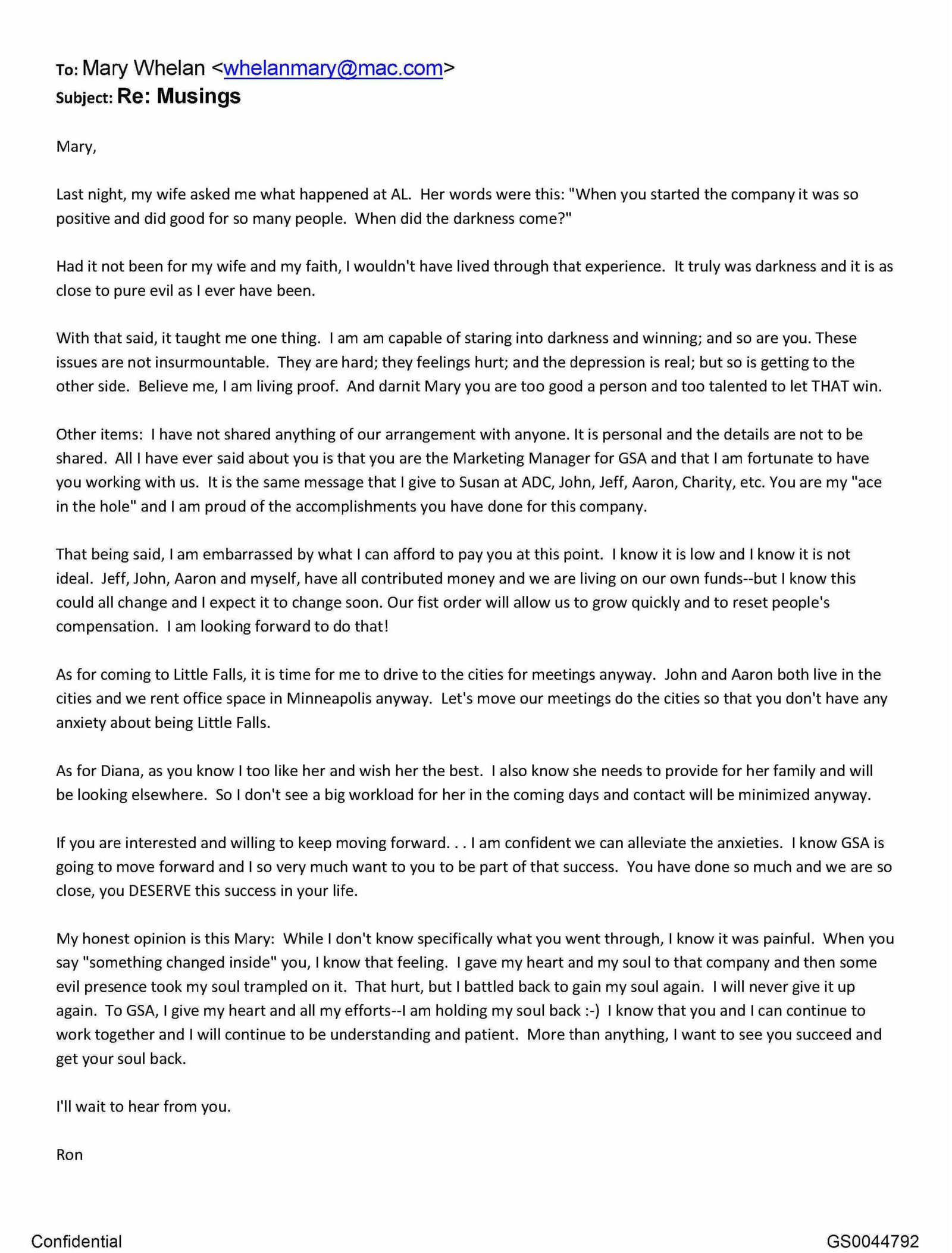
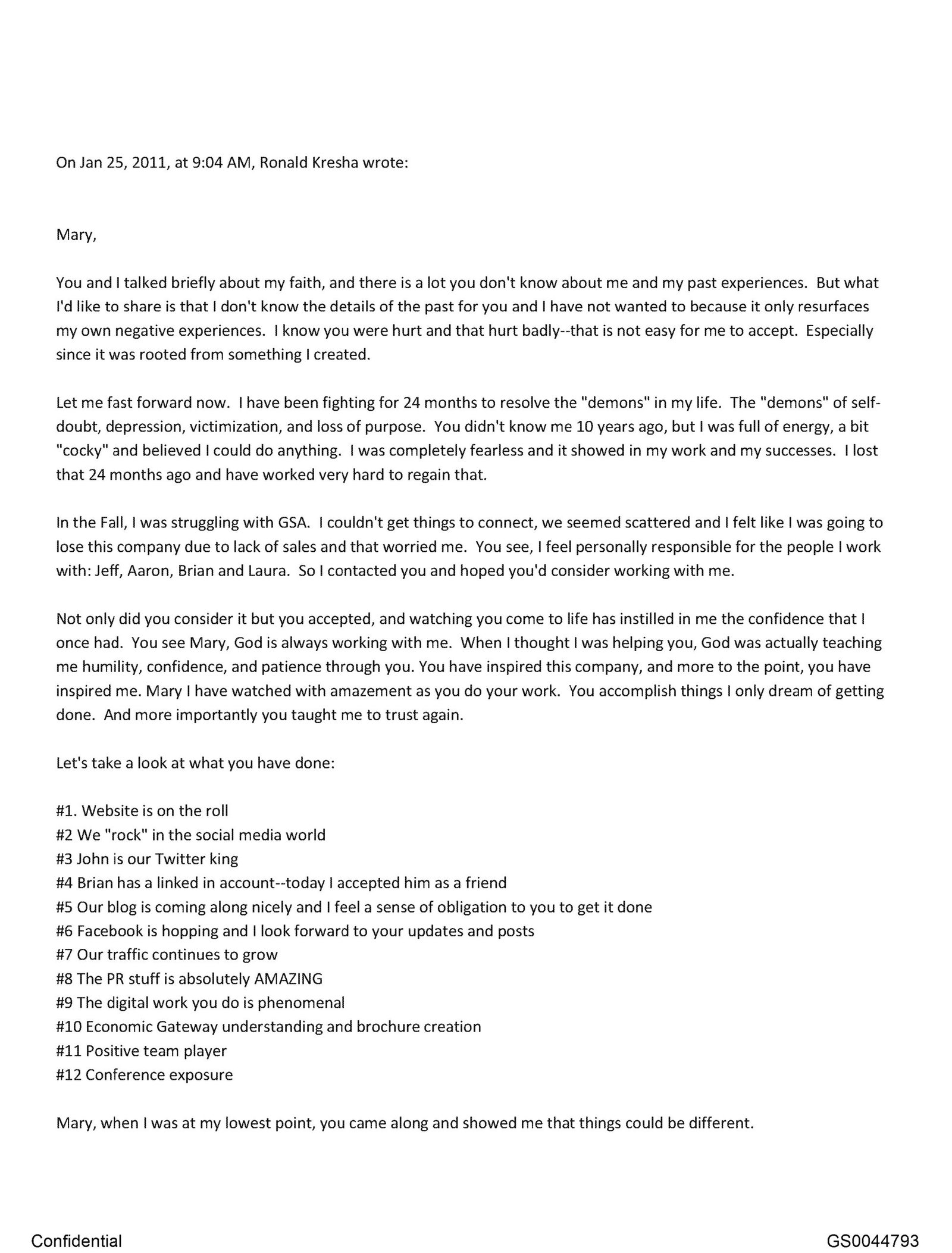
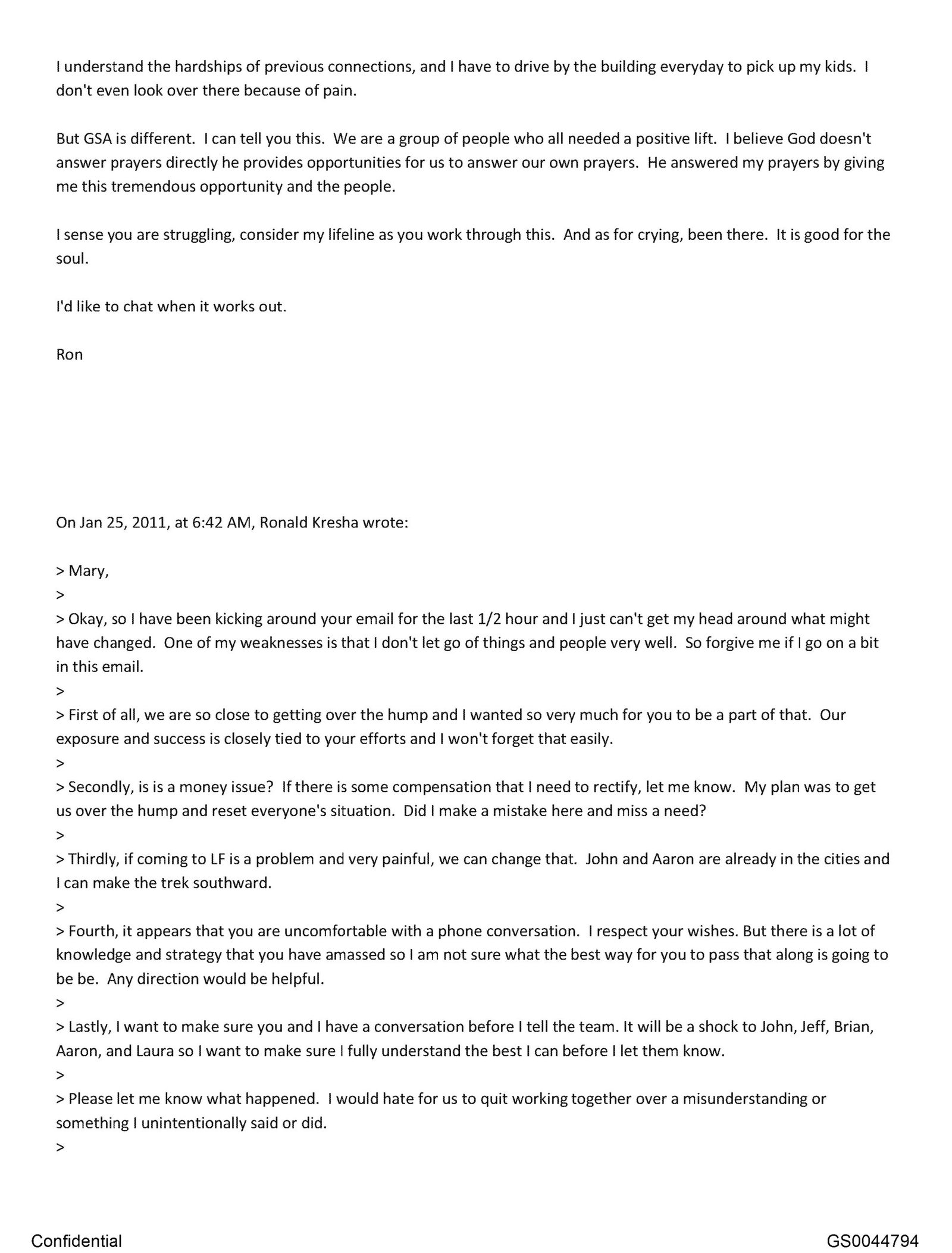
The emails show Ron Kresha attempting to persuade marketing strategist Mary Whelan to continue working with his struggling company (GSA).
He:
-
Acknowledges financial difficulties
-
Praises her marketing contributions extensively
-
Shares personal struggles and faith-based reflections
-
Offers to adjust arrangements to keep her involved
-
Expresses emotional appreciation and encouragement.
The tone combines business discussion, personal vulnerability, and motivational encouragement aimed at maintaining their professional partnership.
1. Ron Kresha Explains Personal Struggles and Business Difficulties
Kresha describes going through a 24-month personal and emotional struggle, including:
-
Self-doubt
-
Depression
-
Loss of purpose
-
Feeling responsible for employees and the company’s survival
He says he had previously been confident and successful but lost that confidence during this period.
2. He Credits Mary Whelan for Reviving the Company
Kresha repeatedly praises Whelan’s contributions and influence, stating she:
-
Inspired him personally
-
Helped rebuild confidence
-
Played a major role in the company’s progress
He lists specific accomplishments he attributes to her work, including:
-
Website progress
-
Strong social media presence
-
Twitter engagement
-
Blog development
-
Facebook growth
-
Increasing website traffic
-
Public relations success
-
Digital marketing work
-
Marketing materials (Economic Gateway brochure)
-
Team collaboration
-
Conference exposure
He calls her work “phenomenal” and says she helped show him that things could improve.
3. The Company (GSA) Was Financially Struggling
Kresha acknowledges:
-
The company was short on money
-
Several team members were contributing personal funds
-
Compensation for Whelan was lower than it should have been
He says he expected future business orders to:
-
Stabilize finances
-
Allow them to reset compensation.
4. He Wants to Continue Working With Her
The emails show Kresha trying to convince Whelan not to leave the project.
He asks whether her concerns might be related to:
-
Compensation
-
Travel to Little Falls
-
Communication issues
-
A misunderstanding
He offers solutions such as:
-
Meeting in Minneapolis instead of Little Falls
-
Adjusting arrangements if necessary.
5. Emotional and Personal Tone
Much of the communication is personal and motivational, not purely business.
Themes include:
-
Faith and God guiding opportunities
-
Emotional support
-
Encouraging Whelan during a difficult time
-
Statements about overcoming “darkness” and depression
He emphasizes that:
-
He believes in her abilities
-
He wants her to succeed
-
He hopes she will remain part of the company’s future.
6. Confidentiality
Kresha says he has not shared details of their arrangement with others and has only described her publicly as:
“Marketing Manager for GSA.”
###