Kresha admitted he had misrepresented employees on his PPP loan applications and had not paid back the loans.
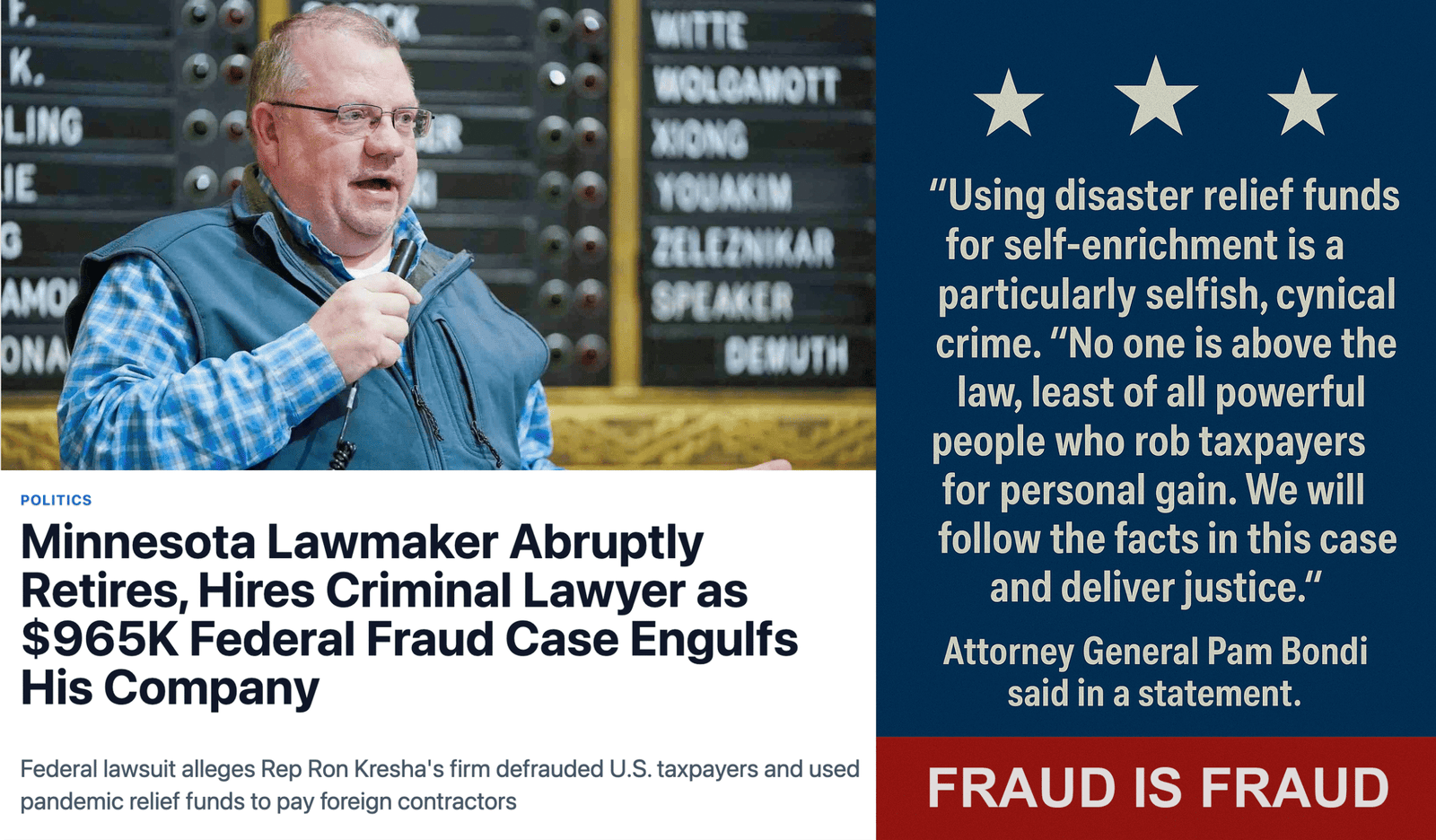
St. Paul, MN — Rep. Ron Kresha’s retirement is being widely interpreted as the final public chapter of a long-running controversy involving questions of financial integrity, economic development contracts, and the handling of taxpayer dollars in central Minnesota. Yet even as Kresha steps away from public service, new information emerging from the federal whistleblower case surrounding Golden Shovel Agency ensures that the underlying issues remain far from settled.
This week, whistleblower Troy K. Scheffler submitted a detailed responsive memorandum in federal court that introduces significant, previously unknown facts into the public record—facts that reinforce the credibility of the allegations involving fraudulent PPP loan claims, misrepresentations about employment structure, and the misuse of federal relief funds.
Newly Revealed Details: Evidence of Unpaid Loans and Private Admissions
Court records show that the case—United States ex rel. Troy K. Scheffler v. Golden Shovel Agency, LLC—is actively moving through the U.S. District Court for the District of Minnesota (Case No. 25-cv-02824). Highlighted in Scheffler’s declaration are shocking details of independently gathered corroborating evidence through a third-party who confirmed that Ron Kresha admitted he had misrepresented employees on his PPP loan applications, had not repaid the loans and later sought loan forgiveness instead. This information was not available to the public, further strengthening Scheffler’s status as an original source under the False Claims Act.
These revelations materially expand the factual basis supporting the fraud allegations and directly contradict prior assumptions about the company’s financial behavior.
Lobbying Conflict-of-Interest Concerns Resurface
Scheffler’s filing reignites scrutiny of Golden Shovel’s political entanglements and potential conflict-of-interest concernstied to relationships between the agency’s leadership and public officials, including Kresha’s historical involvement in lobbying-related activities.
While not the central legal argument, the filing’s references to non-public communications and political ties add weight to long-standing concerns that overlapping political and economic interests may have facilitated or obscured improper conduct.
Local transparency advocates say these connections underscore a key point: Minnesota lacks enforceable guardrails that prevent lawmakers from interacting with, advising, or supporting organizations that later become subjects of fraud allegations.
Retirement Doesn’t End the Questions—But It Does Close an Era
Kresha’s departure from the Legislature may symbolize political closure, but the federal case continues to expand the factual record with each filing.
For many observers, this is the first moment in which Minnesotans are seeing hard, sworn evidence—not just speculation:
-
A non-public deposition confirming no employees existed
-
Private admissions that PPP loans were not repaid
-
Original-source evidence gathered independently
-
Documented timelines of when the U.S. Government was first alerted
-
Lurking conflict-of-interest issues involving political actors and a publicly funded development agency
Scheffler disclosed his findings to the federal government on July 9, 2025, fulfilling statutory requirements for whistleblower actions.
A Turning Point for Minnesota Government Accountability
For local governments, economic development boards, and the Legislature, the case provides a rare window into how gaps in oversight and conflicts of interest can go unchecked for years.
One longtime public accountability advocate summarized the moment:
“Kresha’s retirement might close a political chapter, but Scheffler’s filing makes it clear: the facts are still emerging, and the public deserves to see them.”
###